As Africa celebrates its rich cultural heritage, linguistic diversity, and collective future this Africa Day (25 May), we are reminded that language is more than a means of communication. Language carries memory, identity, imagination, knowledge systems, and a sense of belonging.
Across the continent, millions of children enter classrooms where the language of instruction is unfamiliar to them. Research consistently shows that children learn best when they begin learning in a language they understand,[1] because, language matters. Mother tongue-based learning strengthens literacy development, deepens comprehension, improves participation, and builds confidence. It also creates more inclusive learning environments where children feel seen, heard, and valued.
In this article, the African Storybook team reflects on the role that Open Educational Resources (OER) plays in expanding access to learning in African languages.
OER as a Pathway to Learning in Our Mother Tongues
OER provide opportunities to reimagine access to education across diverse linguistic and cultural contexts. Through open licensing, educational materials can be translated, adapted, localised, and shared legally and collaboratively. This matters deeply in multilingual African contexts where access to quality educational content in local languages remains limited.
Open licensing allows educators, communities, literacy organisations, translators, and publishers to use African Storybook to:
- Translate materials into local and indigenous African languages;
- Adapt stories and educational resources to local realities and contexts;
- Localise names, idioms, cultural references, and examples;
- Share resources widely without restrictive copyright barriers; and
- Collaboratively improve and quality assure educational content.
Localisation is not only about changing words from one language to another. It is about ensuring that children encounter stories, examples, and learning experiences that reflect familiar realities, cultures, environments, and ways of understanding the world.
Why Translation and Localisation Matter
Translation has a multiplier effect. Experiences from African Storybook continue to show the power of translation and localisation when communities are actively involved in the process. Between 2021 and 2024, the ASb team in collaboration with the University of Surrey, facilitated virtual workshop processes on story translation and creation, for Thok Nath (Nuer)-speaking participants, originally from South Sudan. They were recruited from Africa and abroad where they have been dispersed due to conflict. This community-driven initiative resulted in 30 translations and 14 storybooks originated in Thok Nath (Nuer) with their English translations, all published on the website.
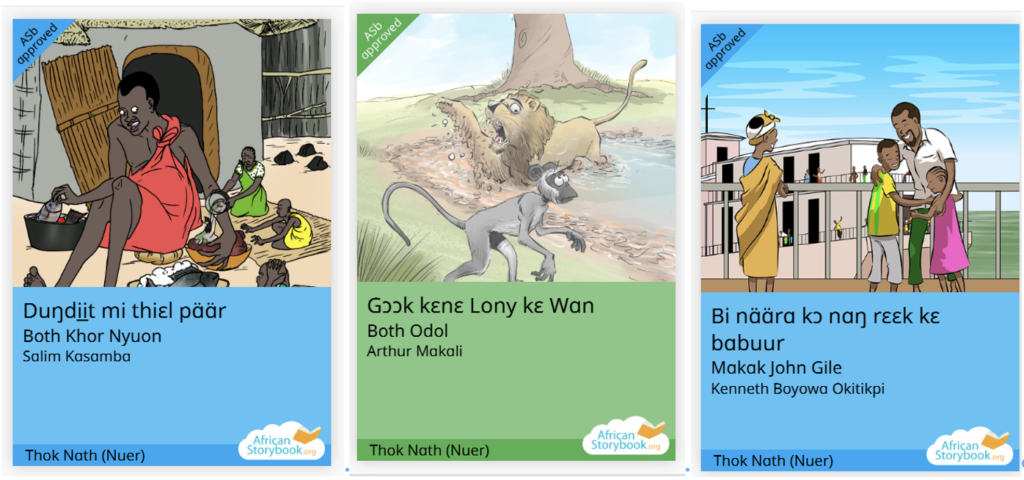
The coordination of the Nuer storybook development was done mainly through a vibrant WhatsApp Group, and in September 2023, a total of 19,500 of the storybooks were printed in Juba, South Sudan as anthologies, and distributed in Sunday schools, which serve as centres for mother tongue education and the hubs for book distribution. Additionally, 250 storybooks were distributed worldwide to various Nuer community groups, scholars, and libraries. The initiative had also planned to print more copies for communities in Ethiopia, Uganda, and Kenya. By September, it was estimated that in and around Juba, about 300 000 children had received the storybooks and were using them.
This community proves how a single storybook can travel across dozens of languages and communities, expanding inclusion and access to reading opportunities for children who may otherwise have limited access to books in their home language.

A Very Tall Man in 90 languages, Friends in 45 languages, Akai’s Special Mat in 40 languages
Translation has a multiplier effect
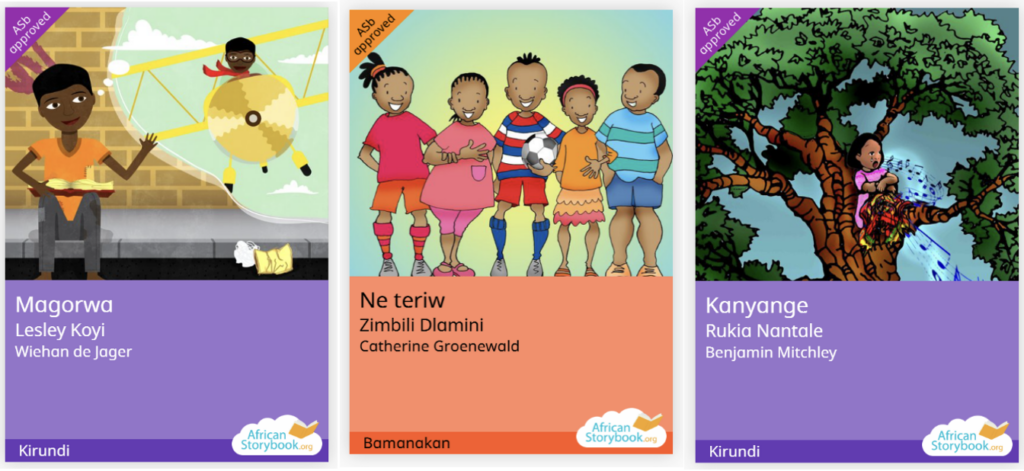
Through collaboration with Right To Play, EMPOWER Mali Project, ASb supported the project team and local experts, to translate storybooks into six official languages of Mali, namely, Bamanakan, Tamasheq, Dɔgɔsɔ, Sonrhai, Fulfulde and French. In addition to translation, the six-language also published three storybooks originated in French and translated into the other five languages. The translation process followed in the EMPOWER Project was replicated in Burundi where 20 storybooks were translated into Kirundi.
Effective localisation often includes:
- Using familiar names, songs, expressions, and references;
- Adjusting language structures for clarity and readability;
- Ensuring that stories align with children’s lived experiences;
- Respecting dialectical differences while maintaining accessibility; and
- Using illustrations to support meaning-making and comprehension.
Community-led translation also builds ownership and agency. Teachers, caregivers, volunteers, literacy champions, and local organisations become active contributors to educational ecosystems rather than passive consumers of content.
Learning in Languages Children Understand
The language of instruction directly impacts learning outcomes.
- Children who learn in familiar languages are more likely to:
- Develop stronger foundational literacy skills;
- Participate confidently in classroom discussions;
- Build comprehension and critical thinking abilities;
- Experience greater emotional connection to learning; and
- Sustain a love of reading and storytelling.
Mother tongue learning also supports equity and inclusion. It creates opportunities for children from linguistically marginalised communities to access education in ways that honour their identities and cultures.
At a time when many African education systems are grappling with literacy challenges, multilingual classrooms, and widening inequalities, investment in mother tongue learning is not optional, it is foundational.
Building an Open, Multilingual Future
Africa’s linguistic diversity is one of its greatest strengths. Open approaches to education create possibilities for collaboration across countries, institutions, and communities to produce educational content that is accessible, adaptable, and rooted in African realities.
As we commemorate Africa Day 2026, OER Africa and African Storybook celebrate the educators, translators, literacy practitioners, publishers, caregivers, and communities working to ensure that every child can learn, imagine, and thrive in a language they understand.
When children encounter stories in their own languages, they not only learn to read. They learn that their voices, cultures, and identities matter.
“Open licensing enables communities to translate, adapt, create and share knowledge across languages and contexts”
Authors: the African Storybook team
[1] UNESCO. (2025). Languages matter: global guidance on multilingual education. Retrieved from https://unesdoc.unesco.org/ark:/48223/pf0000392477